
25 November 2026
Not Every Performance Fee Problem Can Be Solved by Equalization
For decades, Equalization (EQ) has been widely used by hedge funds as a practical solution to address performance fee allocation among investors subscribing at different times.
In a traditional hedge fund structure with a single class, a common NAV, and a standard high-water mark performance fee, Equalization works reasonably well. It helps eliminate "free rides", prevents investors from subsidising one another, and allows the fund to publish a single NAV per share.
However, industry experience increasingly shows that Equalization is not a universal solution.
As investment structures become more sophisticated, particularly where preferred returns, profit-sharing arrangements, subordinated classes, waterfall allocations, and frequent dealing cycles are involved, Equalization begins to break down.
In these situations, Series Accounting is often the more appropriate and economically accurate methodology.
The Fundamental Assumption Behind Equalization
Equalization was originally designed to solve one specific problem:
Investors enter a fund at different times and therefore have different high-water marks and performance fee liabilities.
To address this, Equalization seeks to maintain a single NAV while making accounting adjustments so each investor ultimately bears the correct performance fee burden.
The methodology works best when:
Once these assumptions no longer hold, Equalization starts to lose effectiveness.
When Investors No Longer Have the Same Economic Rights
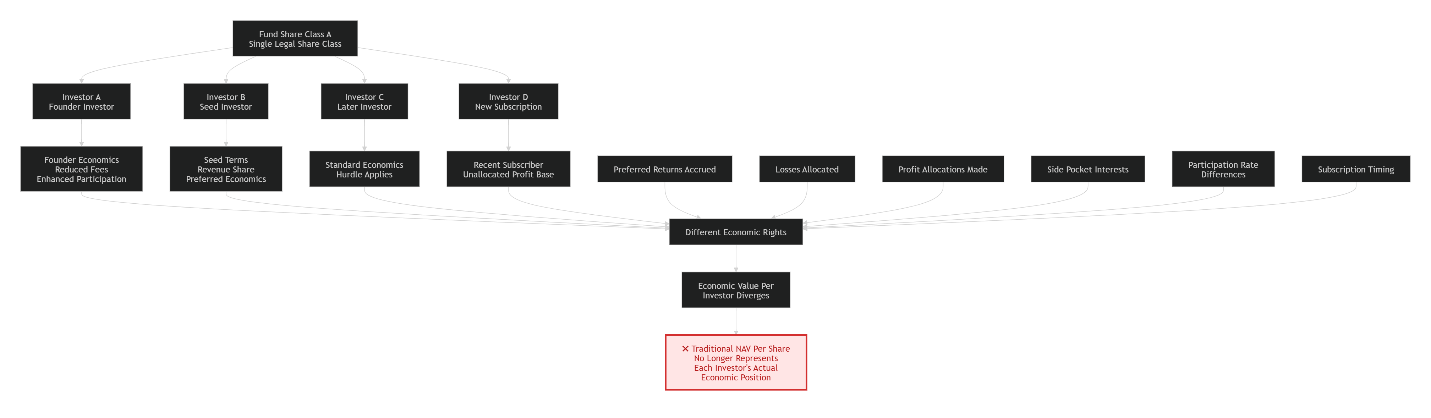
Many modern alternative funds no longer operate with a simple "one class, one performance fee" model.
Instead, they may include:
In these cases, investors may subscribe into the same class but possess fundamentally different economic entitlements depending on:
The result is that a common NAV per share no longer accurately represents each investor's actual economic position.
The Preferred Return Challenge
Consider a fund that offers investors a preferred return arrangement.
Investors subscribing in January begin accruing entitlement to preferred returns immediately.
Investors subscribing six months later only participate from their respective entry date.
Although both investors may hold shares within the same class, their economic entitlements differ significantly.
If all investors are merged into a single Equalized class with one NAV, a practical problem emerges:
The NAV can represent only one average economic position.
It cannot simultaneously represent:
As a result, part of Investor A's entitlement becomes diluted, while Investor B receives economic exposure to value they did not help create.
The issue becomes even more pronounced when subscriptions occur every week.

Why Profit Allocation Creates an Even Bigger Problem
The challenge becomes substantially greater when profit allocations are involved.
Assume that profits are allocated periodically among investors based on capital account balances rather than simply through NAV appreciation.
Each investor's capital account may evolve differently because:
At that point, investors no longer own identical economic interests.
If everyone remains in a single Equalized class, a common NAV effectively averages all these individual economic outcomes.
This inevitably causes distortions.
Some investors receive more than they are entitled to.
Others receive less.
In other words:
Once profit allocations differ by investor, a single NAV per share ceases to be an accurate measure of ownership.
No Equalization formula can fully eliminate this problem.
Why Weekly Dealing Makes the Situation More Difficult
Traditionally, many hedge funds operated with monthly, quarterly, or annual dealing cycles.
Under those circumstances, the operational burden of Equalization was manageable.
However, funds with weekly subscriptions and redemptions introduce a new level of complexity.
Every week may create:
Attempting to maintain these differences through Equalization adjustments quickly becomes operationally cumbersome.
The complexity often grows faster than the benefits that Equalization was originally intended to provide.
The Series Accounting Alternative
Series Accounting approaches the problem differently.
Instead of forcing all investors into one economic pool represented by a common NAV, each subscription period is tracked separately through its own Series.
Each Series effectively maintains its own:
Investors subscribing at different times receive Series reflecting their actual economic participation.
The accounting therefore mirrors the commercial reality.
When conditions permit, Series may later be consolidated.
Until then, the integrity of each investor's entitlement is preserved.

Why Series Accounting Resembles Capital Accounting
Private equity funds and partnerships have long relied on capital account accounting.
The reason is simple:
Partners rarely possess identical economic rights.
Returns depend on:
Series Accounting effectively brings similar principles into an open-ended fund environment.
Rather than averaging economics across investors, it maintains separate economic records and allocates returns according to actual participation.
For strategies involving preferred returns and profit allocation mechanics, this methodology is often considerably more accurate than Equalization.
The question is not whether Equalization is an effective methodology.
For many traditional hedge fund structures, it remains an appropriate and efficient solution. The more relevant consideration is whether the fund's economic structure still aligns with the assumptions upon which Equalization was originally designed.
As fund structures become more sophisticated, investors may no longer share identical economic rights. Preferred return arrangements, profit allocation mechanisms, differentiated participation terms, and frequent subscription and redemption activity can create meaningful differences in investor entitlements over time. In these circumstances, a single NAV per share may not fully reflect each investor's economic participation.
Series Accounting addresses this challenge by maintaining separate economic records for different subscription periods or investor cohorts. This approach is conceptually similar to capital account accounting used in private equity and partnership structures, where allocations are based on underlying economic arrangements rather than a common averaged valuation. Importantly, Series Accounting should not be viewed as superior to Equalization. Both methodologies serve different purposes and are suited to different fund structures. The key consideration is not which methodology is better, but which one most accurately reflects the economic reality of the fund and its investors.
onboarding@precisionfundservices.com
6 Raffles Boulevard, Marina Square,
#03-308, Singapore 039594
2nd Floor, AXA Southside,
38 Wong Chuk Hang Road, Hong Kong
DS Building, No.538 De Zheng Bei Road,
Yue Xiu District, Guangzhou
L6, China Central Place 2, No.79 Jianguo Rd,
Chaoyang Dist, Beijing

Please leave your message, and we will contact you as soon as possible.
Name *
Company *
Email Address *
Mobile Number *