
14 August 2026
In the modern alternative investment landscape, the evaluation of fund administration has undergone a fundamental shift. For years, fund managers selected service providers primarily on fund accounting capabilities, net asset value (NAV) calculation speed, and competitive fee structures. However, recent regulatory changes—most notably the introduction of CIMA's new AML Rule and Sanctions Rule in the Cayman Islands—have highlighted that administrative support extends far beyond operational accounting.
As regulatory bodies elevate previous compliance guidelines into directly enforceable obligations, the quality of a fund administrator's compliance platform has become central to sound fund governance. A qualified administrator serves as an operational partner across the fund's regulatory lifecycle: from investor onboarding and ongoing tax reporting to regulatory audit readiness.
The Regulatory Shift: Beyond Document Collection
As highlighted in recent industry developments regarding Cayman Funds:
"The introduction of CIMA's new AML Rule and Sanctions Rule reflects a broader regulatory expectation that AML compliance should be demonstrable, documented and effective in practice. Many requirements previously contained within guidance have now become directly enforceable obligations. Against this backdrop, the quality of a fund administrator's operational and compliance framework is becoming increasingly important."
This evolution reinforces that compliance is no longer a static box-checking exercise or an administrative matter of gathering passport copies. It requires risk-based judgment, experienced personnel, and records that can withstand audit or regulatory review.
1. Daily Investor Onboarding and Customer Due Diligence (CDD)
Investor onboarding is the front line of financial crime prevention. A low-cost, purely processing-focused administrator can create hidden liabilities down the road if potential risks are overlooked during initial intake. Conversely, an experienced administrator embeds a sophisticated risk-based approach into daily operations.
Value-Add Solutions in Onboarding:
2. Ongoing Monitoring and Sanctions Management
Compliance does not end once an investor's initial subscription is accepted. Risk profiles change over time due to geopolitical developments, shifting ownership, and evolving global sanctions lists.
An operational administrator maintains ongoing monitoring programs to detect changes throughout the investor lifecycle. By conducting periodic Know Your Customer (KYC) refreshes and continuous daily sanctions screening, the administrator helps protect the fund from counterparty risk, severe legal penalties, and reputational damage. When risk triggers occur, clear escalation logs provide complete transparency to the fund's governing body.
3. Tax and Regulatory Reporting: FATCA and CRS Integration
In addition to financial crime prevention, global tax compliance frameworks such as the Foreign Account Tax Compliance Act (FATCA) and the Common Reporting Standard (CRS) require strict operational execution.
Bridging Onboarding to Annual Reporting
A proficient fund administrator unifies investor onboarding with international tax reporting:
4. Navigating Annual CIMA Registered Funds AML Audits
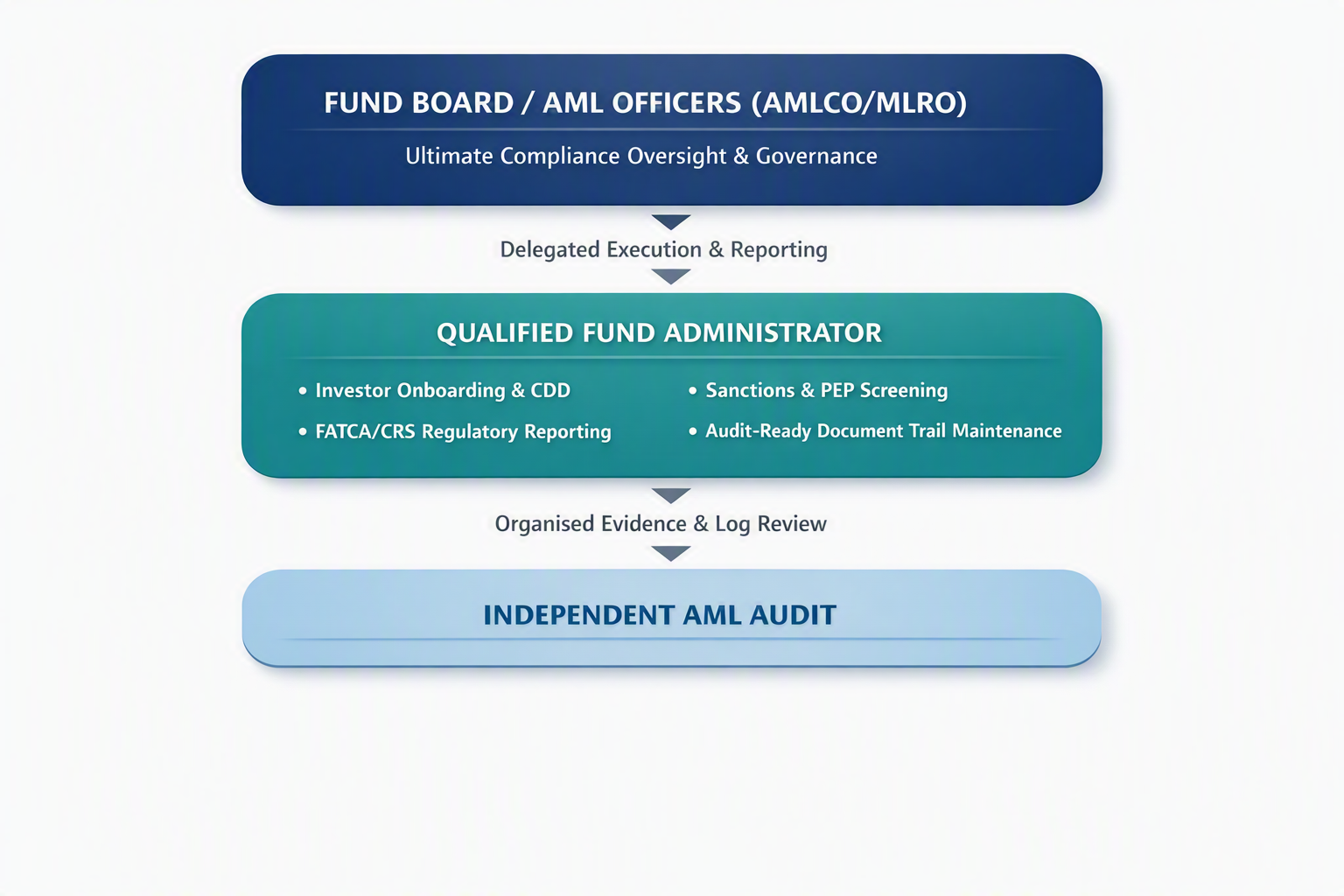
Under CIMA's regulatory framework, registered investment funds must demonstrate an effective, independent compliance program. While ultimate responsibility remains with the fund and its board of directors, the fund administrator acts as the primary source of day-to-day operational evidence during an AML audit.
The updated CIMA guidance on the Independent Audit Function makes clear that the AML audit requirement is not a new concept, but an existing obligation under the AML Regulations that CIMA now expects regulated funds and financial service providers to apply in a more structured and demonstrable manner. Importantly, the audit cycle should be risk-based: an annual audit is not automatically required for every fund, but the frequency, scope and depth should reflect the fund's size, complexity, investor base and overall AML risk profile.
Practical implications for Cayman registered funds:
This is where the role of a fund administrator becomes critical. A qualified administrator does not merely respond to audit requests at year-end; it helps the fund build a practical compliance platform from day one by maintaining investor files, screening records, risk-rating evidence, escalation logs, FATCA/CRS data and governance-ready documentation in a consistent and retrievable manner, so that the fund can demonstrate not only that procedures exist, but that they are being applied effectively in daily operations.
Strategic Value: Protecting Fund Reputation and Investor Confidence
Selecting a service provider based solely on lowest cost can expose a fund to hidden vulnerabilities, particularly when onboarding files, screening records, tax data and audit trails are tested by auditors, counterparties or regulators. The practical difference between a basic administrator and a governance-driven administrator is therefore not only operational efficiency, but the fund's ability to evidence compliance when challenged.
| Operational Focus | Traditional / Low-Cost Administrator | Qualified / Governance-Driven Administrator |
|---|---|---|
| Onboarding Strategy | Basic document collection | Risk-based CDD, SoW/SoF verification, and UBO tracing |
| Sanctions & PEP Checks | Point-in-time initial lookup | Automated, continuous screening and real-time alerts |
| Audit Preparation | Dispersed files; reactive document retrieval | Organized, audit-ready records with clear decision logs |
| Regulatory Risk | Vulnerable to oversight, penalties, and delays | Strong compliance infrastructure supporting fund governance |
Why Operational Quality Now Matters
As regulatory expectations across offshore jurisdictions continue to heighten, compliance quality is no longer invisible. Institutional investors, prime brokers, and regulatory bodies actively evaluate the strength of a fund's operational ecosystem.
By integrating investor onboarding, continuous sanctions screening, FATCA/CRS reporting and audit-ready recordkeeping into a cohesive workflow, a qualified fund administrator turns compliance into a managed operating discipline rather than a year-end remediation exercise. That infrastructure helps safeguard the fund's integrity, investor confidence and long-term reputation.
onboarding@precisionfundservices.com
6 Raffles Boulevard, Marina Square,
#03-308, Singapore 039594
2nd Floor, AXA Southside,
38 Wong Chuk Hang Road, Hong Kong
DS Building, No.538 De Zheng Bei Road,
Yue Xiu District, Guangzhou
L6, China Central Place 2, No.79 Jianguo Rd,
Chaoyang Dist, Beijing

Please leave your message, and we will contact you as soon as possible.
Name *
Company *
Email Address *
Mobile Number *