
3 June 2026
From Back Office Support to Compliance Infrastructure
For years, fund administration has been positioned as operational support — essential, but largely interchangeable.
NAV calculations. Investor reporting. Capital calls.
Reliable outputs, but rarely seen as a strategic lever.
That positioning is shifting.
What's changing is not just the structure of funds, but the environment around them. Capital moves faster, investor bases are increasingly cross-border, and regulatory expectations continue to rise. Within that context, one function has moved into focus:
AML and KYC.
A Structural Shift in Compliance Demands
The pressure on AML/KYC is not cyclical — it is structural.
Private markets are now inherently global. A single fund structure often spans multiple jurisdictions, each with its own regulatory expectations, documentation standards, and compliance nuances. At the same time:
• Onboarding timelines are compressing
• Subscription processes are expected to be seamless
• Transparency around beneficial ownership is non-negotiable
Complexity is no longer episodic — it is cumulative.
Scaling traditional compliance approaches through additional headcount or incremental process layers does not address the underlying challenge.
The Limits of Internal Models
Building AML/KYC as an internal function introduces structural constraints:
• Fixed capacity vs variable demand
Fundraising and onboarding volumes fluctuate, while internal teams remain static
• Process inconsistency
Manual interventions, exception handling, and fragmented workflows introduce variability over time
• Fragmented data environments
Multiple structures, jurisdictions, and processes lead to siloed information and limited reuse
These dynamics create friction at the point where efficiency matters most — onboarding, due diligence, and ongoing monitoring.
The issue is no longer execution. It is model design.
A Different Starting Point
A more effective approach begins with recognising where scale already exists.
The operational infrastructure supporting onboarding, investor data, and multi-jurisdictional structures is already concentrated in one place.
This position provides:
• Direct control over onboarding workflows
• Continuous exposure to cross-border structures
• Ongoing management of investor lifecycle data
• Pattern recognition across multiple funds and managers
The advantage is not incremental — it is structural.
From Execution to Infrastructure
Viewed through this lens, AML/KYC shifts from an activity to a system.
Not a function performed in isolation, but a shared infrastructure layer embedded across fund operations.
This distinction matters.
Infrastructure enables:
• Repeatability
• Consistency
• Scalability
• Compounding intelligence over time
What Scaled Compliance Looks Like
In practice, this model is defined by a set of disciplined capabilities:
Standardised onboarding frameworks
Consistent, repeatable workflows that reduce variability and streamline investor entry
Centralised data architecture
Structured collection, retention, and intelligent reuse of investor information
Systematic risk assessment
Risk evaluation built on accumulated data, not recreated from first principles each time
Continuous lifecycle management
Ongoing monitoring, periodic reviews, and dynamic updates as investor profiles evolve
These are not new concepts.
The difference lies in application at scale and with consistency.
Why It Matters Now
Private markets are expanding — across geographies, investor types, and access points.
As participation broadens, operational trust becomes a defining factor.
• Who is investing
• Where capital originates
• Whether structures are transparent
These questions are answered through AML/KYC.
• When those processes are efficient, consistent, and well-structured, they enable growth.
• When they are fragmented, they introduce friction — operationally and commercially.
A centralised compliance infrastructure removes that friction.
A Gradual but Defining Transition
This shift does not happen overnight. It builds through:
• Increased reliance on externalised KYC frameworks
• Greater standardisation across onboarding processes
• Consolidation of data and documentation handling
• Stronger confidence in centralised compliance models
Over time, the perception changes — from support function to enabling layer.
Enabling Market Participation
The direction is clear.
Investment is moving towards:
• More integrated onboarding workflows
• Unified data environments
• Cross-border compliance capabilities
• Consistent operating frameworks
The objective is not to do more work. It is to enable participation at scale.
Final Perspective
Markets scale when infrastructure is robust.
In public markets, that infrastructure is visible — exchanges, clearing systems, custody networks.
In private markets, it is less obvious — but equally critical.
It sits within:
• onboarding frameworks
• risk assessment models
• data integrity
• compliance execution
When these elements operate as a coherent system, they enable confidence, efficiency, and growth.
AML/KYC is no longer a supporting function.
It is part of the infrastructure that allows private markets to function at scale.
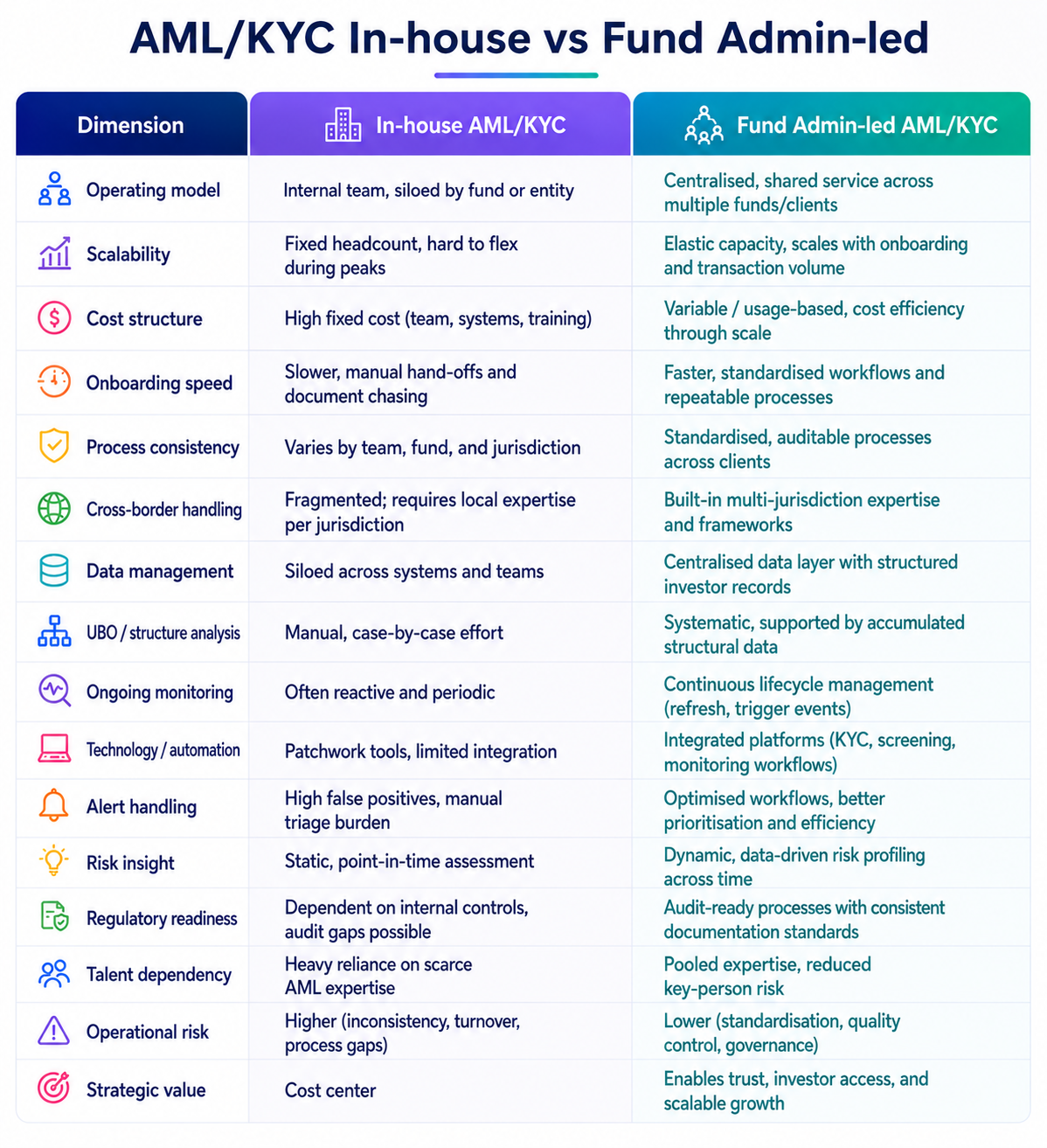
Comparing In-House and Fund Admin-Led AML/KYC
| Dimension | In-house AML/KYC | Fund Admin-led AML/KYC |
|---|---|---|
| Operating model | Internal team, siloed by fund or entity | Centralised, shared service across multiple funds/clients |
| Scalability | Fixed headcount, hard to flex during peaks | Elastic capacity, scales with onboarding and transaction volume |
| Cost structure | High fixed cost (team, systems, training) | Variable / usage-based, cost efficiency through scale |
| Onboarding speed | Slower, manual hand-offs and document chasing | Faster, standardised workflows and repeatable processes |
| Process consistency | Varies by team, fund, and jurisdiction | Standardised, auditable processes across clients |
| Cross-border handling | Fragmented; requires local expertise per jurisdiction | Built-in multi-jurisdiction expertise and frameworks |
| Data management | Siloed across systems and teams | Centralised data layer with structured investor records |
| UBO / structure analysis | Manual, case-by-case effort | Systematic, supported by accumulated structural data |
| Ongoing monitoring | Often reactive and periodic | Continuous lifecycle management (refresh, trigger events) |
| Technology / automation | Patchwork tools, limited integration | Integrated platforms (KYC, screening, monitoring workflows) |
| Alert handling | High false positives, manual triage burden | Optimised workflows, better prioritisation and efficiency |
| Risk insight | Static, point-in-time assessment | Dynamic, data-driven risk profiling across time |
| Regulatory readiness | Dependent on internal controls, audit gaps possible | Audit-ready processes with consistent documentation standards |
| Talent dependency | Heavy reliance on scarce AML expertise | Pooled expertise, reduced key-person risk |
| Operational risk | Higher (inconsistency, turnover, process gaps) | Lower (standardisation, quality control, governance) |
| Strategic value | Cost center | Enables trust, investor access, and scalable growth |
onboarding@precisionfundservices.com
6 Raffles Boulevard, Marina Square,
#03-308, Singapore 039594
2nd Floor, AXA Southside,
38 Wong Chuk Hang Road, Hong Kong
DS Building, No.538 De Zheng Bei Road,
Yue Xiu District, Guangzhou
L6, China Central Place 2, No.79 Jianguo Rd,
Chaoyang Dist, Beijing

Please leave your message, and we will contact you as soon as possible.
Name *
Company *
Email Address *
Mobile Number *